Lab and field

Sand-free strings. Measurable rate.

Treatments have been bullheaded or coiled-tubing placed in Texas (proppant flowback), Canada, Venezuela, India, and West African unconsolidated sand.

40%+Average production increase
0Sand after dual-string treatment
21%Liquid permeability gain, tight sand
50+Days stable with no sand
Case study

Dual completion in unconsolidated sand ~8,000 ft

Both strings were treated before production start. The well had been completed as a dual cased-hole producer in Agbada-type unconsolidated sand.

  • Lab: 21% improvement in liquid permeability on tight sand
  • Lab: 157% improvement in relative permeability on 20/40 mesh
  • Field: zero sand production after treatment
  • Field: production up at least 40%; one string later documented at 10× versus its impaired baseline
  • Improved injectivity while bullheading
  • Stable for 50 days with no sand-related re-entry
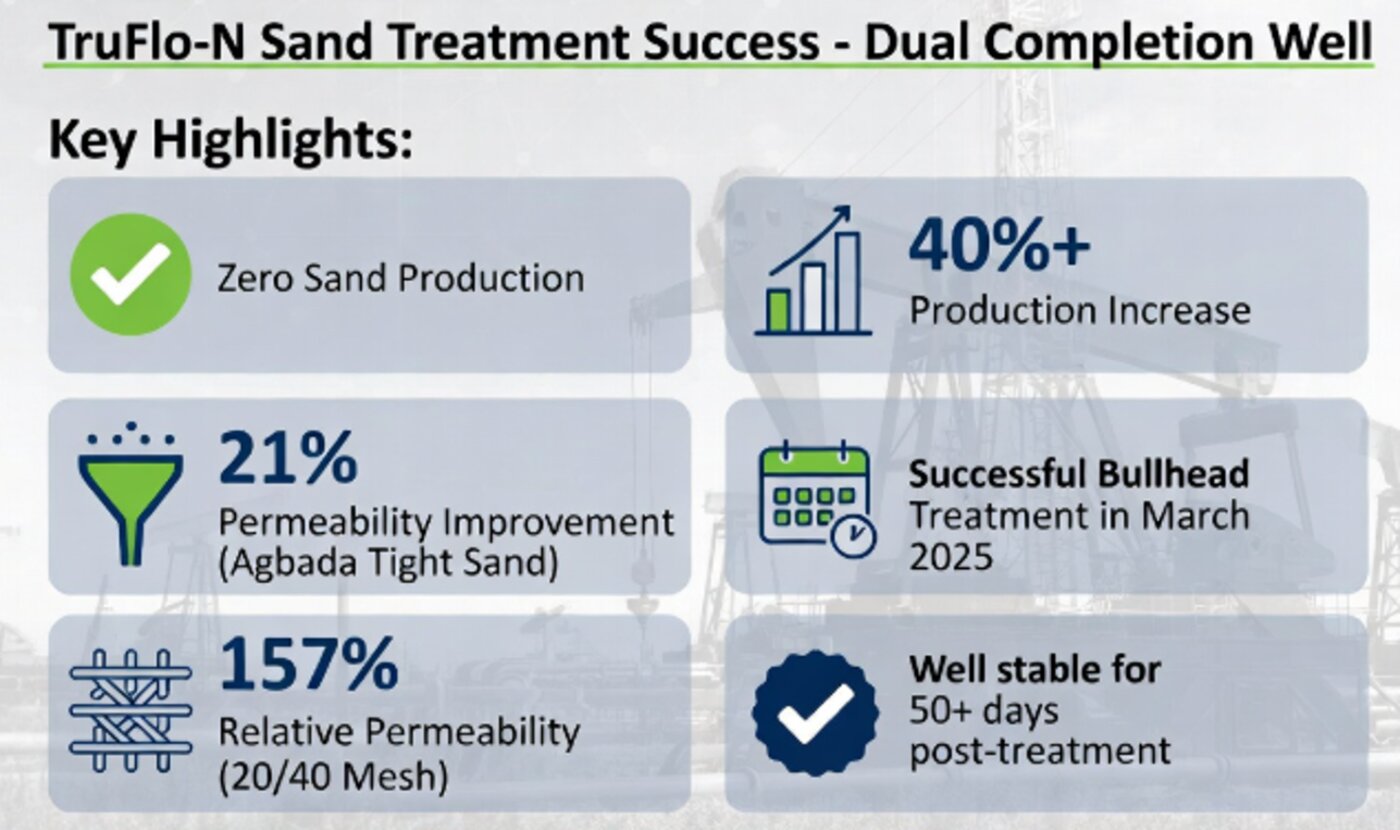
Summary metrics from a TruFlo-N dual-completion treatment

What that is worth operationally

Fewer CT cleanouts

Sand-prone wells often take two to three coiled-tubing interventions a year. Each trip is commonly six figures. Holding sand downhole removes that cycle.

Rate without raising MSFR risk

Operators no longer have to choke back to a maximum sand-free rate that leaves reserves in the ground.

Injectivity on water wells

Where sand-face impairment cuts injectivity 3–4 months after stimulation, aggregation plus a DS clean-up is the cheaper path versus another pack or liner.

Screen a candidate well