1. Adsorption
Polymer adsorbs onto sand grains and formation fines in aqueous solution.
TruFlo-N is a water-dispersible polymer that reprograms grain-surface charges so sand forms porous aggregates — not a glued, damaged pack.
Polymer adsorbs onto sand grains and formation fines in aqueous solution.
Surface ionic charges are modified. Attractive and repulsive forces rebalance.
Particles form larger, stable, porous clusters that resist migration.
Sand stays put. Oil flow paths stay open. Water permeability drops.
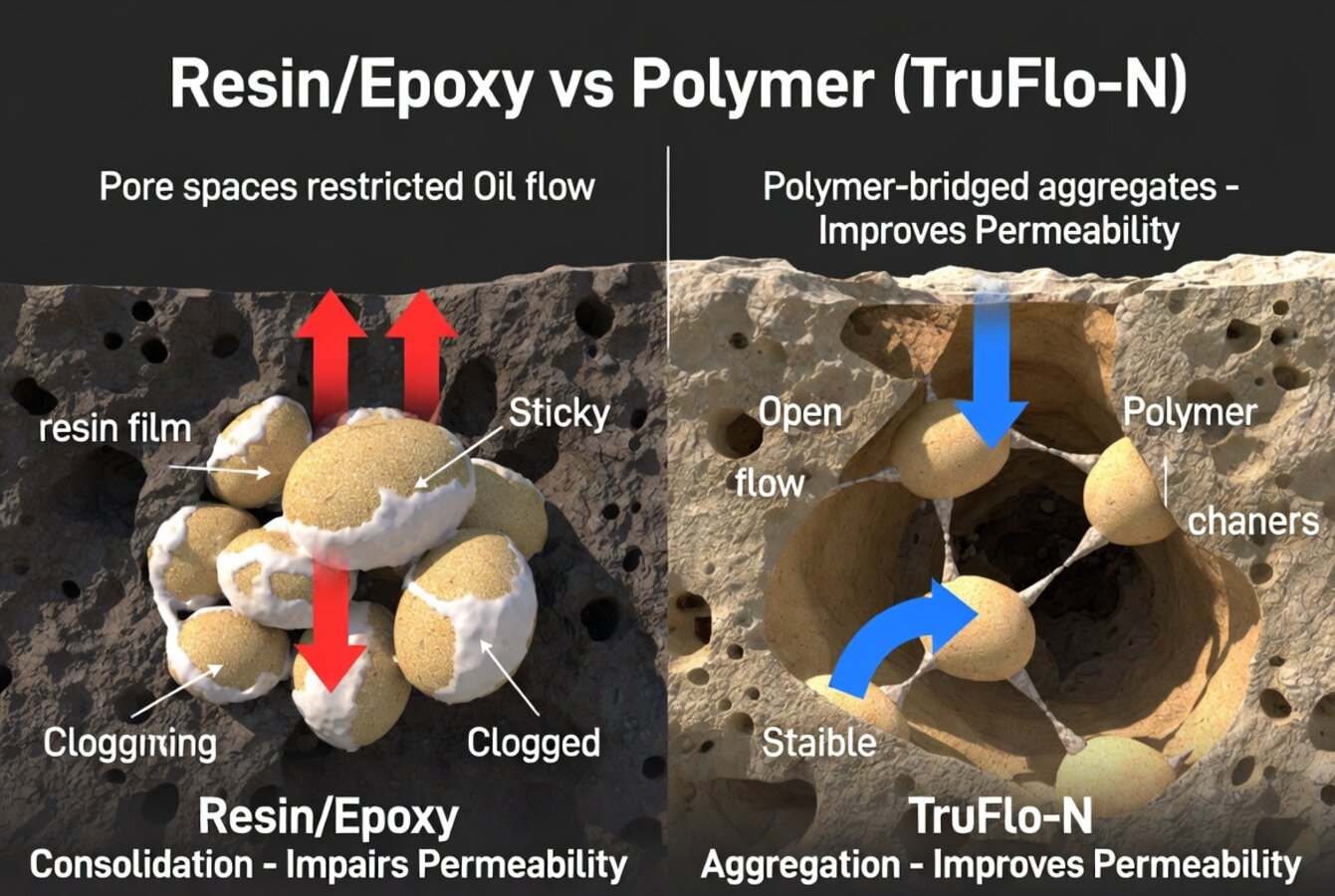
Resin coats grains with a rigid film and often impairs permeability. TruFlo-N does not replace natural cement. It works with the rock fabric.
| Principle | Surface-charge attraction, not a sticky film |
|---|---|
| Oil permeability | Maintained or improved |
| Water permeability | Preferentially reduced |
| Damage risk | Very low when a post-flush is used |
| Placement | Bullhead or coiled tubing; longer intervals with diverters |
| Retreatment | Straightforward |
Aggregates create open pore networks that favor the oil phase. Surface-charge effects hinder water mobility in the treated zone. Operators typically see higher oil rate at the same or lower water cut.
Displace tubing and interval with 2–6% KCl brine (or 7% KCl / NH4Cl where clay control is required).
Pump a formation-conditioner pill (KCl + surfactant) to strip oil film and prepare surfaces for adsorption.
Pump 2–6% KCl with 5–10% TruFlo-N. Bullhead, or reciprocate coil tubing across perforations. Target about 1–3 ft radial coverage.
Limited KCl overflush. Shut in 12–24 hours. A post-flush is required to avoid overtreatment; acid can reverse an overtreat.
Bring the well back slowly. Track sand, oil rate, and water cut. Retreatment is possible if the well needs it later.
| State / color | Liquid, dark red to dark brown |
|---|---|
| Odor | Pungent amine or ammonia |
| Specific gravity @ 25 °C | Approx. 1.0–1.2 |
| pH | 6–8 |
| Solubility | Soluble in methanol; dispersible in brines at low concentration |
| Flash point / viscosity | > 65 °C / < 2000 cps @ 20 °C |